Practical guide · GEO
GEO audit: a checklist to test your site for AI search
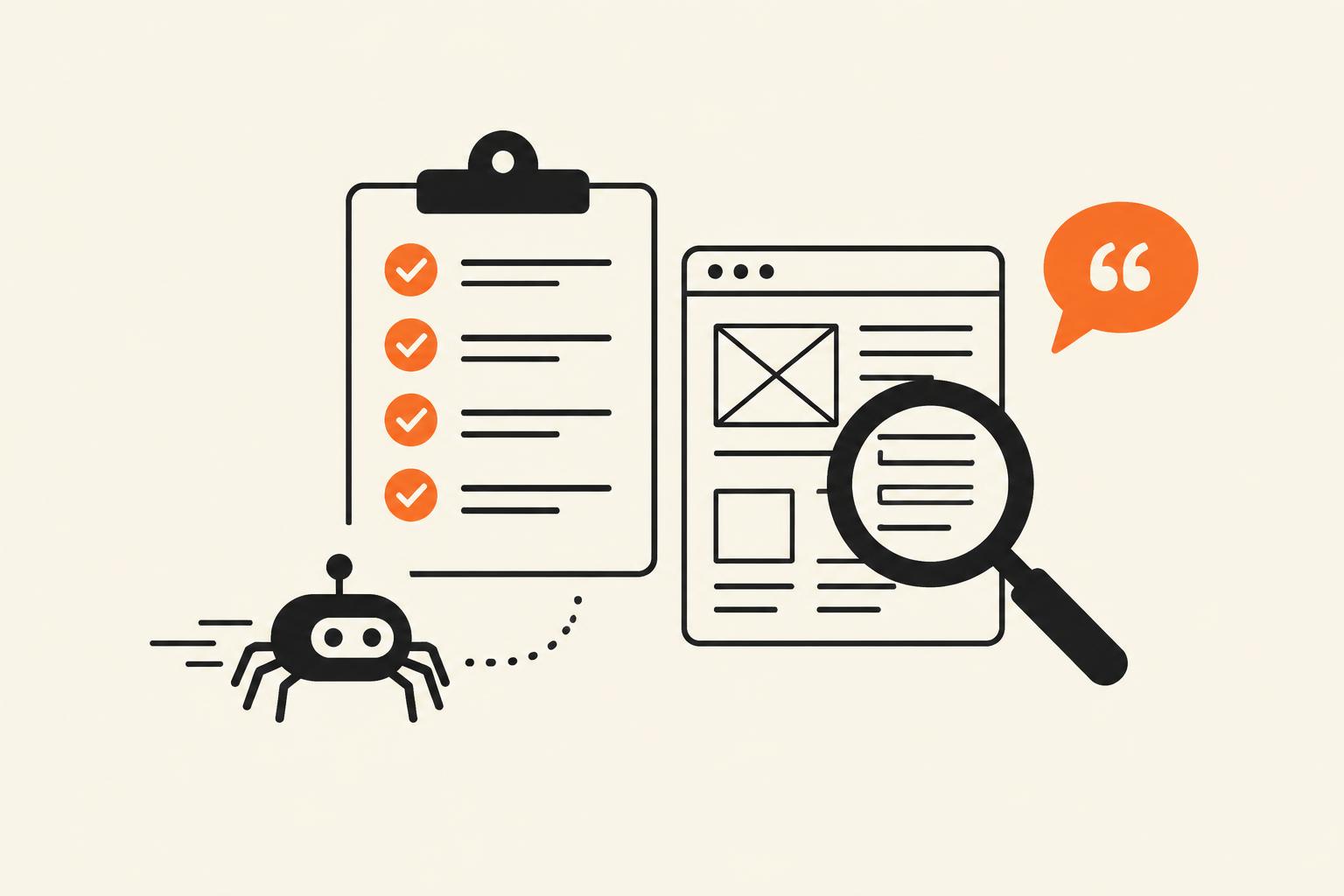
A GEO audit (Generative Engine Optimization) is a review of your site to find out whether AI answer engines such as ChatGPT, Gemini, AI Overviews or Perplexity can crawl it, understand it and cite it. It builds on a standard SEO audit and adds three questions: can AI crawlers reach the pages, are answers easy to extract, and is the publishing entity clearly identified?
Want to know why your site does not show up in AI answers? This audit first checks what depends on you, before measuring results.
Key takeaways
- A GEO audit starts with access: a crawler blocked in robots.txt cannot cite a page it has not read.
- Google says no special optimization is required for AI Overviews and AI Mode: an indexed page eligible for a snippet is technically enough.
- Search crawlers and training crawlers are separate at OpenAI and Google: you can block training without leaving the answers.
- Measuring citations comes after the audit: fix access and structure first, then track answers.
GEO audit vs SEO audit: what is the difference?
Most answer engines rely on a search index: Google’s for AI Overviews, AI Mode and Gemini, Bing’s or their own crawlers for ChatGPT and Perplexity. A poorly indexed site therefore stays invisible in AI. A GEO audit does not replace an SEO audit; it checks its foundations first.
What it adds covers three points: access for AI-specific crawlers, how easily an answer can be extracted from a passage, and how clear the entity is (who publishes, on what topic, with what evidence). It does not promise a citation: no AI vendor publishes a rule guaranteeing a page will be used.
Sources: Google Search Central: AI features and your website
Block 1: can AI crawlers reach your pages?
Open your robots.txt file and look for AI-specific agents. At OpenAI, OAI-SearchBot powers ChatGPT search and GPTBot model training: they are set separately. At Google, Google-Extended controls use for Gemini but does not affect Googlebot or Search ranking. Perplexity documents PerplexityBot.
Also check what blocks silently: a firewall or bot protection returning errors to crawlers, pages that only show their text after JavaScript runs, content behind a login. A simple test is to fetch the page without a browser and confirm the main text is in the HTML.
| Crawler | Stated use | What to check |
|---|---|---|
| Googlebot | Google Search, AI Overviews, AI Mode | Allowed and pages indexed in Search Console |
| Google-Extended | Use for Gemini models | Deliberate choice: blocking does not affect ranking |
| OAI-SearchBot | ChatGPT search results | Allowed if you want to be cited in ChatGPT |
| GPTBot | OpenAI model training | Independent from the previous choice |
| PerplexityBot | Perplexity results | Allowed and not blocked by the firewall |
Sources: OpenAI: crawlers (OAI-SearchBot, GPTBot) · Google: common crawlers and Google-Extended · Perplexity: crawlers
Block 2: are your pages indexed where AI looks?
In Search Console, check the indexing status of your key pages and the exclusion reasons. Do the same in Bing Webmaster Tools, since some answer engines rely on web search results beyond Google. An up-to-date sitemap with real modification dates helps both.
For each key page, note: indexed or not, correct canonical, no noindex tag, HTTP 200 status. This is the most measurable part of the audit, and often the one that unlocks the most.
Sources: Google Search Central: AI features and your website · Bing Webmaster Tools
Block 3: is an answer easy to extract?
Answer engines reuse passages. For each page, check that a definition or direct answer appears early, that H2 headings phrase the reader’s real questions, and that comparable data sits in tables or lists rather than buried in a paragraph.
Review structured data: the right type (Article, FAQPage, Product, Organization), valid syntax and above all consistency with visible text, a rule Google restates. Markup describing something other than the page adds nothing and can cost rich result eligibility.
Block 4: are your entity and evidence clear?
An AI summarizing a topic needs to attribute information. Check for an author page, an About page, the same brand name everywhere, sources cited for figures and real publication dates. Google’s self-assessment questions on helpful content work as a grid.
Then look beyond your site: official profiles, mentions in sources from your field. These signals cannot be fixed in a day, but the audit lets you list inconsistencies (name, description, offer) to align.
Block 5: what do AI tools already say about you?
Once the first four blocks are checked, ask ChatGPT, Gemini and Perplexity a fixed list of questions your customers ask, and note whether your site is cited, mentioned or absent, and which sources appear instead. Keep the same questions month to month to compare.
These answers vary with wording, account and timing: a one-off check is a clue, not a stable measurement. That is why this audit puts measurement last, and the full method is covered in a dedicated guide.
What action plan after the audit?
Prioritize what blocks access, then what hinders understanding, and only then reputation work.
- List 10 to 20 key pages and their main intent.
- Fix robots.txt, firewall and JavaScript rendering issues that prevent text from being read.
- Resolve indexing issues reported by Search Console and Bing Webmaster Tools.
- Add a direct answer at the top of each page and question-style H2 headings.
- Align structured data, author page and brand information with visible content.
- Record AI citations on a fixed question list, then repeat the audit in a month.
Frequently asked questions
Sources and limitations
Documentation check on November 13, 2026. Access and eligibility rules are those published by Google, OpenAI, Perplexity and Bing on that date; they may change. Rankio does not publish citation rates: the checklist above describes what can be verified, not a guaranteed outcome.
- Google Search Central: AI features and your website: No extra technical requirement to appear in AI Overviews and AI Mode: a page must be indexed and eligible for a snippet.
- Google: common crawlers and Google-Extended: List of Google crawlers; Google-Extended controls use for Gemini models without affecting Search ranking.
- OpenAI: crawlers (OAI-SearchBot, GPTBot): OAI-SearchBot for ChatGPT search, GPTBot for training, controllable separately in robots.txt.
- Perplexity: crawlers: PerplexityBot and how it treats robots.txt.
- Google: introduction to structured data: Role of structured data and the requirement to match visible content.
- Google: creating helpful, reliable content: Self-assessment questions on usefulness, expertise and transparency of content.
- Bing Webmaster Tools: Bing tool to submit a site, track indexing and diagnose crawling.